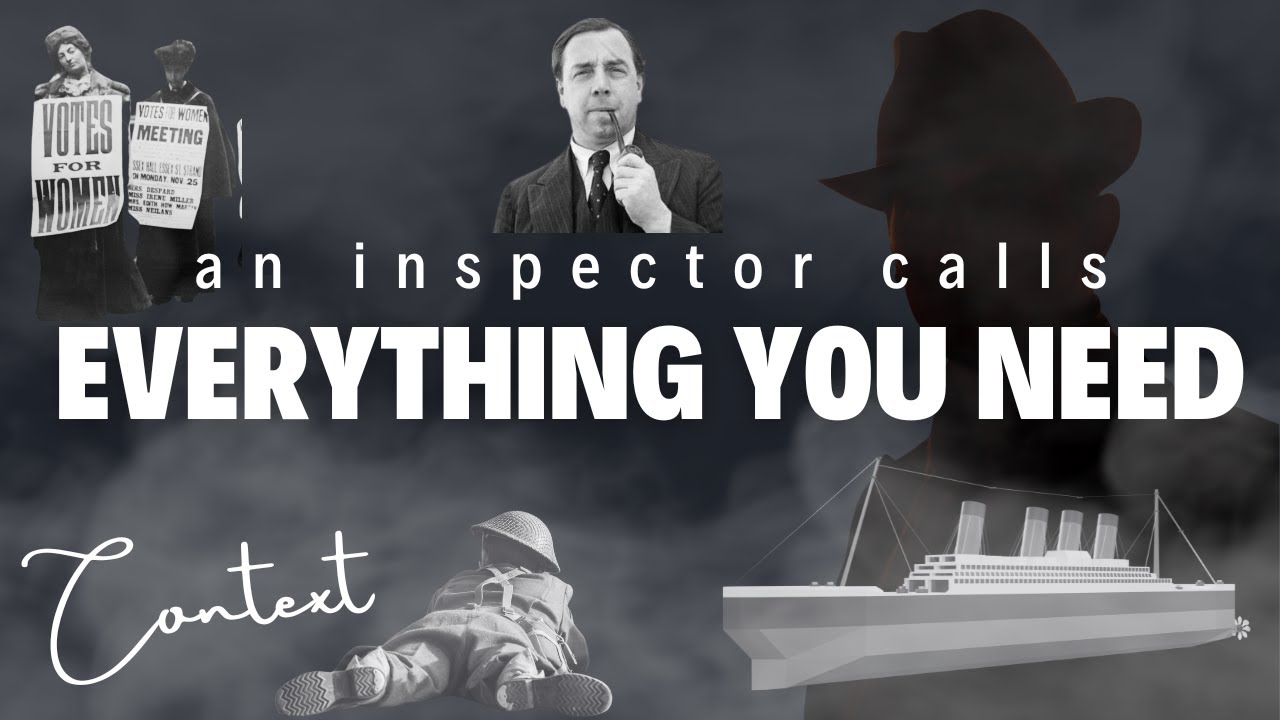
Sophisticated Vocabulary for An Inspector Calls Essays
Examiners are naturally swayed by precise, sophisticated expression. However, high-level vocabulary isn't about using long words for the sake of it - it's about finding specific terms that unlock deeper insight into the play's themes and characters. Moving from calling Mrs. Birling "mean" to describing her as "supercilious" or "callous" instantly sharpens the quality of your analysis.
In this video, I introduce a curated list of high-level vocabulary designed specifically for An Inspector Calls essays. For every word, I explain its definition, demonstrate how it connects to key characters and themes, and walk you through specific quotes where it can be applied. Master these words to elevate both the eloquence and analytical depth of your writing.
Timestamp
0:00 the importance of sophisticated vocabulary
0:33 Callous
1:52 Supercilious
3:30 Expedient
4:14 Unconscionable
5:40 Adversity
6:55 Pervasive
8:20 Microcosm
9:25 Remorse
11:09 Perpetuate
14:40 Disparity
16:39 Advocate
18:17 Zeitgeist
This video is on my YouTube channel. However, there are a few benefits to watching it here instead:
- You can register to keep a track of which videos you’ve watched
- You can bookmark lessons for later
- There may or may not be no ads, but I can neither confirm nor deny and I definitely didn't tell you if YouTube asked, OK?
There are also resources to help you in the Study Materials section:
An Inspector Calls Vocabulary Bank
The words in this vocabulary bank will help you to develop a more sophisticated and high level understanding of the key ideas and concepts in 'An Inspector Calls'.
As well as providing a range of words, their definitions and an example sentence, this book also suggests a number of activities that you can use to revise and put the vocabulary into practice.
Bonus - it's completely free!
An Inspector Calls AQA GCSE Model Answers (Coming soon!)
This resource will have model answers for multiple years of AQA past papers, giving you the ability to see what high grade essays look like for a range of essay questions.
An Inspector Calls Edexcel IGCSE Model Answers (Coming soon!)
This resource will have model answers for multiple years of Edexcel past papers, giving you the ability to see what high grade essays look like for a range of essay questions.
An Inspector Calls Flipped Learning (Coming soon!)
This resource is designed for teachers and students: it is a workbook designed to be completed alongside all of my An Inspector Calls videos. It is essentially a structured way for you to take notes and ensure that you are squeezing every ounce of advice my videos have to offer.
I fully intend to add more videos and study materials on this play. If there's something in particular you're looking for, then register and get in touch to let me know what would help you.
Lesson Transcript:
Vocabulary is so important, not just in ensuring that we're talking about the play in an accurate way, but also in a more specific, articulate way that's going to give us that ability to access more insightful ideas. So, I'm not only going to be telling you about the words themselves, but I'm going to be telling you how you can apply them to the play and showing you some quotes as examples. So, let's do this!
The first word we're going to look at is callous. Now, in An Inspector Calls, Mr. and Mrs. Birling have a callous attitude towards the suffering of others. And "callous" is a person who is very cruel and shows no concern for other people or their feelings. I should add, by the way, that all of my definitions for the words in this video come from Collins Dictionary. I'm not in any way sponsored by them, but I just think they are the best dictionary for young people to use because their definitions are so accessible.
Going back to Mr. and Mrs. Birling being callous, you can see, for example, in this quote where Mrs. Birling says:
"I don't suppose for a moment that we can understand why the girl committed suicide. Girls of that class—"
—and then she gets cut off. Now, this shows that she's callous because it's like she's heard, at this point of the play, loads of information about the different things that Eva went through, and she's still, like, can't see why she would do that. And also, just in general, the idea that they could never understand why working-class people do what they do: there's a complete lack of empathy there, a complete lack of understanding of the suffering of others. This is a really important trait that Mr. and Mrs. Birling have because, of course, Priestley is trying to make us dislike them and dislike their values and their beliefs, which are more capitalist, unempathetic, unsympathetic; and making them seem callous is part of the way that he does that.
He also presents them as being supercilious. So, when you say that someone is supercilious, you disapprove of them because they behave in a way that shows they think they are better than other people. And both Mr. and Mrs. Birling clearly think they are better than the lower classes. So if you take this example quote from Mr. Birling, he says to the Inspector:
"How do you get on with our Chief Constable, Colonel Roberts? [...] Perhaps I ought to warn you that he's an old friend of mine..."
He's very subtly threatening the Inspector at this point with a: "I have power over you. I know powerful people and can make your life hell." And it's that kind of subtle threat there where he's suggesting he knows important people, he is an important person, and therefore the Inspector needs to show him some damn respect!
With Mrs. Birling, you again get that sense of her being supercilious. For example, in this quote, this time she's talking about Eva when Eva pretends to be Mrs. Birling in order—well, a Mrs. Birling—in order to get help for her pregnancy. And Mrs. Birling says:
"It was simply a piece of gross impertinence—quite deliberate—and naturally that was one of the things that prejudiced me against her case."
The "impertinence"—that's like being rude, being impolite. So for Mrs. Birling, Eva has not shown enough respect to her position as a higher-class woman. And so again, it's this sense of: "I am better than you. I am higher class than you. You need to show me respect." It's also really significant that she says "naturally that was one of the things that prejudiced me against her," as if being supercilious, believing in this hierarchy—the betters and the lowers—is a normal and common and natural way to think. So they are both callous and supercilious.
We also see, particularly with Mr. Birling, that he is willing to do something expedient. Now, if something is expedient to do, it is useful or convenient to do it, even though it may not be morally right. And for Mr. Birling, it was expedient for him to fire Eva. For example, he says:
"It's my duty to keep labour costs down."
So, it is expedient for him to prioritize the business's profits, even though it's not morally right perhaps that he underpays his workers.
All of these different things—the fact that Mr. Birling is expedient, the fact that they're both callous and supercilious—all of these negative qualities that they have combine to make us view their behavior as being unconscionable. If you describe something as unconscionable, you mean that the person responsible for it ought to be ashamed of it, especially because its effects are so great or severe.
So, Priestley suggests that the Birling family's behavior towards Eva is unconscionable. And we can see that in this quote from the Inspector when he says:
"She was here alone, friendless, almost penniless, desperate. She needed not only money, but advice, sympathy, friendliness. You've had children. You must have known what she was feeling. And you slammed the door in her face."
And he's talking to Mrs. Birling at this point. So he's basically trying—Priestley is trying to highlight to our audience how their essentially selfish behavior harms others, and it's completely unacceptable, the level of harm that it causes, and they should be ashamed of the level of harm that they cause to others. And you can really see that in that metaphor of slamming the door in somebody's face, with a door symbolizing opportunity, and therefore it being slammed: it's like she's deliberately closing it. And we get that as well from the fact that it's in the active voice: "You slammed the door." The responsibility here is on Mrs. Birling as being the one to close the opportunity out. And that word "slammed," in its violence and power, suggests that those on the top really work powerfully to exclude the working classes from opportunities, from support, from help.
This quote is also another one that helps to demonstrate that Eva experiences a lot of adversity. Now, adversity is a very difficult or unfavorable situation, and Eva, as we hear as the play goes on, faces a lot of it. Another quote that demonstrates it is this from the Inspector:
"With no work, no money coming in, and living in lodgings, with no relatives to help her, few friends, lonely, half-starved, she was feeling desperate."
If you're looking for a full analysis of this quote, check out my video doing a detailed analysis of key quotes for the Inspector. What I'll just say for now is that this highlights all the different ways she was facing adversity. You can see in the list the different items in the list representing the different forms of adversity: so you've got like work, money for her livelihood; lodgings for her housing; relatives, friends, and lonely for her social situation; half-starved for her access to basic needs like food. So we see how much adversity she faces. And so this is all part of what makes the Birling family's behavior so unconscionable, because we see the adversity that she faces, and we are also told that that is as a direct consequence of the callous actions taken by Mrs. Birling, the expedient actions taken by Mr. Birling, and so on.
The play doesn't just leave the problem as being with Eva, though. Part of what Priestley is trying to do is to suggest that the issues experienced by Eva are pervasive throughout British society at the time. And when something, especially something bad, is pervasive, it means that it's present or felt throughout somewhere. So that basically means the struggles, the adversity that Eva faces in the play, are true of working-class people throughout Britain, because it's a pervasive issue.
And the Inspector also makes that clear in his final speech when he says:
"One Eva Smith has gone—but there are millions and millions and millions of Eva Smiths and John Smiths still left with us, with their lives, their hopes and fears, their suffering and chance of happiness, all intertwined with our lives, and what we think and say and do."
And again, I've done a full analysis of this line in my Inspector quotes video, but really this quote is about bringing this whole issue of the play not just about Eva anymore, but about the whole of society. So that reference to Eva Smiths and John Smiths: they are each now symbolizing working-class women and working-class men, and how everything that they do, as shown with that metaphor of being "intertwined with our lives," everything that happens to them is directly linked to the behaviors of people like the Birlings. So this is an issue not just for Eva, but—and again, we get it from that repetition of "millions" there—loads and loads of working-class people throughout Britain.
In that sense, the play An Inspector Calls can very much be seen as a microcosm of British society. So, a microcosm is a small society, place, or activity which has all the typical features of a much larger one, and so seems like a smaller version of it. So the events of An Inspector Calls are a microcosm for events that occur in British society. And that is part of—if I just talk about the play itself and the genre of the play—that is part of why Priestley went for such a realist style. That means, you know how the setting of the play is like a real living room—well, no, I keep saying living room, it's their dining room—and it does the fourth-wall staging where it's like we're just peering inside somebody's dining room? He was trying to really authentically recreate Edwardian Britain, so we really felt that sense of: these issues are real, this happens for real in Britain. And we get it from that exact same quote as I've just looked at; it's that exact same sense from there as well. He is reminding us of all the real people out there who are affected by these issues, by the adversity created by people who do what is expedient to make money rather than what is morally right.
While Mr. and Mrs. Birling don't show any regret for what they've done, Eric and Sheila do, and we can talk about that being remorse. Remorse is a strong feeling of sadness and regret about something wrong that you have done. Eric and Sheila feel deep remorse, whereas Mr. and Mrs. Birling don't have any. And you can see an example of that in this little extract from the play:
Eric: "It's still the same rotten story whether it’s been told to a police inspector or to somebody else... The money's not the important thing. It's what happened to the girl and what we all did to her that matters."
Sheila: "Eric's absolutely right. And it's the best thing any one of us has said tonight and it makes me feel a bit less ashamed of us. You're just beginning to pretend all over again."
Birling: "...They're so damned exasperating. They just won't try to understand our position or to see the difference between a lot of stuff like this coming out in private and a downright public scandal."
For Eric and Sheila, what matters is their actions and the consequences of their actions. Conversely, what matters for Mr. and Mrs. Birling is not what they've done and whether it's wrong or not, but whether society will hold them to account for it, whether there will be public or legal repercussions for their actions. They will happily do something wrong and feel no remorse if society at large will either not know about it or will accept it. If there is any sense of a scandal or a law case, then they've got an issue; then they're concerned, because suddenly it's going to affect them.
One of the warnings that Priestley has against the likes of Mr. and Mrs. Birling and the way that they're behaving with their lack of remorse is he points out that if you don't change the way you behave, it will perpetuate. If someone or something perpetuates a situation, system, or belief, especially a bad one, they cause it to continue. So Priestley suggests if society does not learn from the past, then these problems will perpetuate.
And we see that in the way that An Inspector Calls ends. When Mr. Birling, Mrs. Birling, and Gerald were kind of patting themselves on the back of, "Oh, he wasn't a real inspector, this wasn't a real problem, everything's fine," and then they get the phone call: a girl has killed herself, an inspector is coming around to talk about it.
And this links, again, to the genre of the play with it being a time play. Priestley was really influenced by people who—scientists who came up with these theories about time, and so he then wrote what became known as time plays: plays that look at the concept of time. And there are two theorists in particular that influenced An Inspector Calls.
One is Ouspensky. Now, I know this is a lot of text, but we need to understand their theories and then we can look at how it applies to An Inspector Calls. For Ouspensky, he argued that when we die, we re-enter our life once more from the beginning. (I should add, by the way, I don't think I said they were scientists; I have no idea if they were actual scientists—just reading that first sentence, I'm suddenly thinking maybe they weren't scientists!) When we die, we re-enter our life once more from the beginning. We are born again to the same parents and continue to repeat all the events of our life as before. This cycle of identical lives would go on being repeated if we changed nothing of significance. If, however, we made significant improvements, we convert the circle into a spiral of events that would eventually open the way for us to escape from the repetitions and into a new life in which we did not repeat our mistakes. So we absolutely see that in An Inspector Calls, because Mr. and Mrs. Birling don't change anything; they revert back to the way they were before, and so the cycle repeats: they get the phone call, an inspector is coming around.
He was also influenced by Dunne, and Dunne said you can be given the ability to see forward in time as well as looking back. This would mean that just as you can look back and see what actions led to your present situation, you could also look forward to see the consequences of your actions. So if you wished, you could change those actions and so avoid the consequences.
Now, there's two parts to this. This is, again, the way that An Inspector Calls ends. So it's like all of the investigation with the Inspector was almost the Birlings getting an opportunity to see forward into time and do their reflecting ahead of time. And so then the events that we don't get to see of the second round of investigating: hopefully, that second time, they can change the way they respond—not avoid the consequences, because she's already dead, but, you know, they can learn now: "Okay, yeah, I do need to change this time around."
It also, I think, has an application for our audience watching An Inspector Calls, in that Priestley is reminding the 1945 audience of what society used to be like and the consequences of their actions, as a means of encouraging them to reflect on the future and how they can change things in the future. So there is also an element there of: he's trying to encourage his audience to think about the past and how they can change their actions in the present in order to avoid any potential consequences in the future, and change by becoming more socialist. He is arguing that this problem is perpetuating throughout British society: it existed in the Edwardian times, it still exists now, but also that we need to change that; we need to stop these issues around the class system perpetuating.
Specifically, what he wants to stop perpetuating is the disparity between them. That adversity that Eva faces shouldn't be happening. And a disparity is when there's a notable difference between two things. And in the case of British society and the families in An Inspector Calls, he's wanting to highlight the disparity that's created by the class system: the disparity in life outcomes, life experiences, by being working class versus being middle class or something like that.
And there's this great quote from the play that exemplifies that. Mr. Birling says:
"If you don't come down sharply on some of these people, they'd soon be asking for the earth."
He's essentially showing a huge awareness of the class system there: "if you don't come down sharply on these people." So he's aware, again with him being supercilious, he is aware of him being in a higher position, a higher class, better than the working classes, and there's a sense of him needing to keep those working classes in control, otherwise they're going to want everything—"the earth" representing like more resources than they should have.
The Inspector then flips that metaphor brilliantly by saying:
"It's better to ask for the earth than to take it."
So he flips the verbs from "ask" to "take," and there he actually condemns the class system whereby the upper classes are taking more than their fair share and leaving behind the working classes with not enough, basically.
So that's just one example. Of course, all of the different things that we hear about that happened to Eva are part of highlighting that disparity. The contrast between Sheila and Eva is again part of highlighting that disparity, because they're designed to be like foils to one another. (If you aren't familiar with that term, have a look at my Mr. Birling video or any of my other videos analyzing the Inspector Calls characters; I use that term all the time in those. But basically, "foil" just means you're like opposites: the characters are opposites of one another and contrast one another.) Eva and Sheila are a contrast; they are foils because it's about highlighting the disparity: you know, working-class woman versus middle-class woman, similar age, what their lives are going to be like, and how different their lives are going to be.
Of course, the reason that Priestley is pushing so hard these ideas about, you know, the disparity of the class system and condemning that disparity is because he is an advocate for socialism and social reform. So, an advocate of a particular action or plan is someone who recommends it publicly. You know, he is not hiding the fact that he is a socialist, and this is a very overtly socialist and anti-capitalist play, and he communicates that via the Inspector.
So the Inspector is like his mouthpiece for expressing his socialist ideas. And again, in the Inspector's final speech that is just jam-packed with socialist values of social responsibility and collectivism, he says:
"We don't live alone. We are members of one body. We are responsible for each other."
So really explicitly there, with that metaphor of being "one body": we need to be all functioning together, we rely on each other to succeed and to thrive. And that explicit line: "we are responsible for each other"—we need to help each other. The whole play is about advocating for more social reform, more socialism. And he achieves that in the way that he presents Mr. and Mrs. Birling negatively with their callous behavior, versus your Inspector, who is pushing for what is right, and trying to end the disparity, and trying to change things so that this issue doesn't perpetuate.
This is again, of course, all a microcosm for Britain itself, which was moving towards—not being socialist, but becoming—taking on more socialist values. So the NHS is going to be created a few years after this play was first performed, and things like that. We were becoming a more socialist country in our political legislation.
And in that sense, the play also serves as a zeitgeist. So, the zeitgeist of a particular place during a particular period in history is the attitudes and ideas that are generally common there at that time, especially the attitudes and ideas shown in literature, philosophy, and politics. Now, I would argue that Priestley captures the zeitgeist of post-war Britain: that Labour Party movement, that swinging to the left of "cradle to grave," needing to look out for one another, needing to look after one another. He is capturing that spirit and he is pushing for more.
So he in part captures that spirit by actually reminding us of our past and what things were like in the past, and then also, via the Inspector, our much more modern—modern by 1945 standards—modern beliefs and values, more socialist values, and how those are much better.
And again, the exact same quote to support that idea:
"We don't live alone. We are members of one body. We are responsible for each other."
That really captures a lot of the Labour Party movements that were coming out at this time with the idea of the "cradle to grave": you would be taken care of by the government from the day you were born to the day that you die. And, of course, things like our creation of the NHS. They wanted to build loads of homes, they wanted to create more equality, more support for the working classes, more support for the vulnerable, for the poorest in society, which was a huge shift away from our 1912 past.